You sit beside a window and feel a chill. Moving your chair farther into the room makes it more comfortable, so you assume outdoor air must be coming through the frame.
That is one possibility, but it is not the only explanation.
A cold surface can affect comfort even without a confirmed air leak. Indoor air can also cool beside the glass and move downward, creating a sensation that resembles a draft.
For homeowners across the GTA and Hamilton area, distinguishing these situations helps make replacement decisions more specific. The goal is to establish what contributes to the discomfort, then discuss what the proposed work is expected to improve.

Three Different Experiences Can Feel Like a Draft
The word “draft” often describes a sensation rather than an established cause.
You may be experiencing outdoor air entering through an unintended path. You may be feeling indoor air moving after it cools near the window. Or you may feel colder because your body is losing heat toward a cooler surface.
Natural Resources Canada explains that cold convection currents are often mistaken for window air leaks. It also notes that a person can feel cold near a cold window even when the room temperature is relatively high.
These effects can overlap. Identifying one does not automatically rule out the others.
That is why “this corner feels cold” is useful information, but not a complete diagnosis.
Describe Where the Discomfort Occurs
Start with the location.
Is the chill concentrated beside a particular frame edge? Does it affect the whole seating area? Is the floor near the window uncomfortable, or does the entire room feel cooler than adjoining rooms?
Use a photograph or simple room sketch to show where you notice it.
Record:
- The affected window.
- Where you normally sit or stand.
- How close that position is to the opening.
- Whether the sensation occurs across the window or at one point.
- Whether other windows in the room feel similar.
A statement such as “the chair beside the lower-right corner feels uncomfortable during windy weather” provides more direction than “all our windows are drafty.”
Note When It Happens
Conditions matter.
Does the discomfort appear mainly during wind? Is it present whenever outdoor temperatures are lower? Does it change after curtains close or the heating begins operating?
Keep a short record rather than relying on one moment.
| Observation | Useful Detail to Record |
|---|---|
| Wind-related discomfort | Which opening and where the sensation is strongest |
| Persistent cold near the glass | Whether it occurs during calm conditions too |
| Cooler floor area | Location and relationship to furniture |
| Changes with coverings | Whether curtains or blinds were open or closed |
| Whole-room discomfort | Whether other parts of the room feel affected |
Do not wait for a particular weather event before reporting an ongoing concern. Existing observations are enough to start the conversation.
Check Normal Operation Without Forcing Anything
A window that has not closed normally needs attention, but avoid forcing the handle or sash to test it.
From a safe, accessible position, note whether:
- It closes in the usual way.
- The lock operates normally.
- A gap is visibly different from before.
- The sash appears displaced.
- Hardware is damaged or loose.
Report a change in operation separately from the comfort complaint.
For example:
The room feels cold near this window, and the handle has recently become difficult to close.
Those two observations may be related, but the assessment should establish how.
Do not dismantle hardware or apply improvised adjustments based on a general online instruction. Product-specific servicing may be needed.
Consider the Area Around the Window
The window unit and its connection to the surrounding wall are different parts of the assessment.
If air leakage is suspected, the investigation needs to distinguish the relevant area rather than assuming that the glass or operating sash is responsible.
Ask whether the concern involves:
- An opening component.
- Hardware or seals.
- The frame.
- The installation perimeter.
- Another part of the adjacent wall.
A proposal should explain which part the work addresses.
Replacing the unit while leaving a relevant surrounding issue unresolved may not deliver the intended result. Equally, a local concern does not automatically justify replacing every window in the room.
Include Furniture and Coverings in the Discussion
The arrangement around a window can influence local conditions.
Natural Resources Canada notes that deep sills, closed coverings and nearby furniture can restrict air movement and allow cool air to collect near the glass.
Describe the room as you normally use it. Include the sofa, desk, curtains, blinds and nearby heating outlets.
You do not need to empty the room to explain the problem. Photographs of the ordinary arrangement may be more useful than photographs taken after everything has been moved.
Avoid assuming that changing a covering is a complete solution. It is one factor to consider alongside the window and the wider room.
Do Not Use Condensation as Proof of Air Leakage
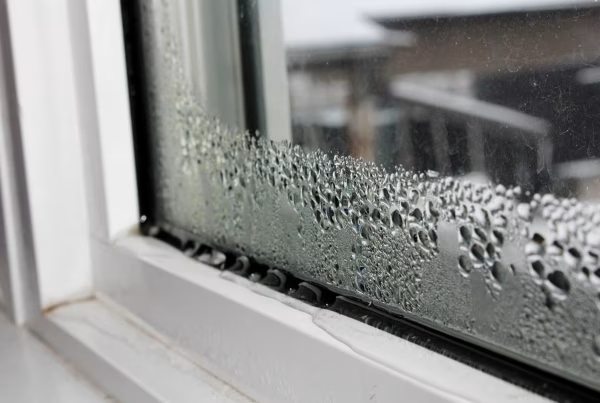
Moisture near a window and a cold sensation can occur together, but one does not establish the other’s cause.
Record where the moisture appears: on the room-facing surface, outside or apparently between panes.
Room-side condensation does not, by itself, indicate glass failure, as Andersen’s product guidance explains.
If water collects around the sill or damages finishes, report that too. It needs assessment rather than being folded into a general “drafty window” description.
Keeping the symptoms separate gives the contractor a clearer picture:
- Comfort concern.
- Moisture concern.
- Operating concern.
- Visible damage.
The findings can then establish which are connected.
Ask What the Assessment Can Confirm
A useful assessment should distinguish observations from conclusions.
Ask:
- Was an air-leakage path identified?
- What was observed about the window’s condition?
- Could the surrounding installation be assessed?
- Are there limits to the findings?
- Is another type of investigation appropriate?
A visual inspection may not answer every question. Where further assessment is proposed, ask what it is intended to establish.
Avoid using flames or improvised pressure tests to investigate the opening yourself. A professional can explain which methods are appropriate for the property and concern.
Connect Replacement to a Defined Improvement
Replacement windows can be part of a comfort improvement, but the proposal should explain why the selected product and installation suit the findings.
Natural Resources Canada identifies reduced drafts and a warmer interior window surface among the comfort benefits of properly installed energy-efficient windows. Those benefits still depend on the actual product and installation.
Ask what the proposed work is expected to address:
- A confirmed defect.
- A particular installation concern.
- The performance of an existing window.
- A change in operation or configuration.
- More than one of these.
Our window and door installation service should be discussed in those terms.
A promise that “the room will never feel cold again” would go beyond what a window specification alone can establish.
Compare Options Against the Original Complaint
When reviewing a proposal, return to the reason you sought help.
If your concern is discomfort beside a desk, ask how the proposed solution relates to that location. If the window does not close normally, ask how that condition is being addressed.
Do not let the conversation become solely about frame colours or the number of glass panes.
Those selections matter, but they should support a defined outcome.
Where other building conditions may contribute, clarify what sits outside the window project. That helps you understand both the value and the limits of the proposed work.

Keep a Record for Follow-Up
Save the initial photographs, your observations and the agreed scope.
If installation proceeds, ask for the relevant operating and care instructions. Record any outstanding items and how to report a concern.
Later, describe changes under comparable conditions where practical. Avoid judging the entire result from one unusually mild day or a single uncomfortable evening.
A clear before-and-after record supports a more useful follow-up discussion than a general statement that the room feels different.
Frequently Asked Questions
Can a window feel drafty without outdoor air coming through?
Yes. Indoor air can cool near the glass and move downward, and a cold surface can affect comfort without a confirmed air leak. These effects can also occur alongside leakage, so the cause needs assessment.
Does condensation prove that a window is leaking air?
No. Condensation and air leakage are different concerns. Record where the moisture forms and describe any operating or comfort problems separately. The assessment should establish which conditions are connected.
Will replacing the window make the whole room comfortable?
A suitable replacement and installation may address a defined window-related concern. However, the room’s wider conditions may also contribute. Ask what improvement is expected and what remains outside the project before approving the work.
Explain the Chill Before Choosing the Window
Knowing where and when discomfort occurs helps connect the replacement discussion to a real household need.
Considering new windows for your GTA or Hamilton home? Request a quote from PanoramaLux and tell us which areas feel uncomfortable, how the windows operate and what you want to improve.